
Reflections on Hospital in the Mind
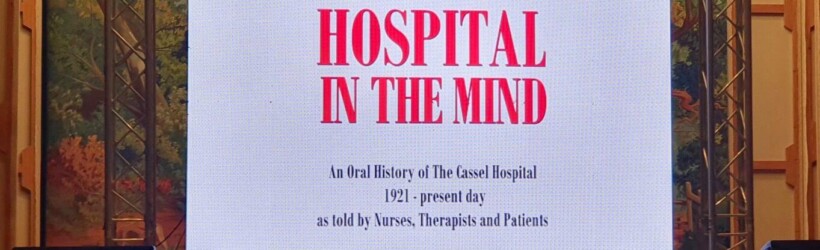
“This inspiring film set out to raise awareness of the Cassel as a national resource. It achieved that aim and more”, according to Jill Anderson, a member of Critical and Creative Approaches to Mental Health Practice (CCrAMHP).
Reflecting on the audience reactions to the screening of the Cassel Hospital Centenary film “ Hospital in the Mind’, on 19 March, for members of the Lancaster CCrAMHP group (Critical and Creative Approaches to Mental Health Practice), Jill summed up the view of of one mental health practitioner in the group, who said: “There are people I’ve worked with for whom I would have accessed this kind of service if I’d known that it existed.”
The audience was made up of 15 people with experience of receiving, refusing, providing, researching and studying mental health services, or encountering them in other ways. Some of them had lived in, attended or worked in therapeutic communities and/or been involved in researching them.
People found the film extremely moving, with one saying that they felt like crying and several commented on how well it worked to have people talking – throughout – direct to camera.
As Jill explains:
“We liked that it wasn’t made explicit, from the outset, who the speakers were; that is, staff or patient. The idea in the film of ‘two minds beginning to find out about each other’ was in tune with how we understand relationships in our own group.
“It felt rare to us, to hear deep emotion conveyed with such clarity. The film’s speakers were experienced, by us, as: ‘ rational. . . reflective. . . . calm,. . . contained. . . dispassionate. . . . objective’. One person was impressed by how articulate, one young woman in the film had been, about not having words!
“We had a sense, from the film, of how proud people were – looking back – of what they had achieved in their lives; grateful too for what the Cassel had offered them.
“Opinions were divided in the room, about the extent to which this kind of brave, spacious and creative environment can be found where we are. What we did agree on is that such instances seem scattered, that it seems hard for them to coalesce and thus impact on mainstream services. We were intrigued by what the film had left unsaid, or at least had gone unheard by us. ‘What did those others feel’, one of our group members asked, ‘those for whom the Cassel didn’t work?’. We were left with questions too about how the Cassel’s positive, enabling practice manages to survive, and even thrive, within the current system.
“But Hospital in the Mind did much more for us. The film articulated things that are not often spoken about in ways that are not often said. Firmly rooted in the here-and-now of the Cassel (as well as its there-and- then), it generated open, frank discussion – as well as some hope and optimism – in the here-and-now of our film screening room.”
Providing an open space
The CCrAMHP group has been meeting in Lancaster for 15 years, as an open space in which Critical and Creative Approaches to Mental Health Practice can be explored.
CCrAMHP supports people who feel ‘constrained’ – ‘cramped’, even – by current services and wish to discover, and share, alternatives. For further information visit their website https://www.ccramhp.org.uk/
Jill Anderson is a researcher on the Madzines research project and a member of the editorial collective of a Asylum, the radical mental health magazine.